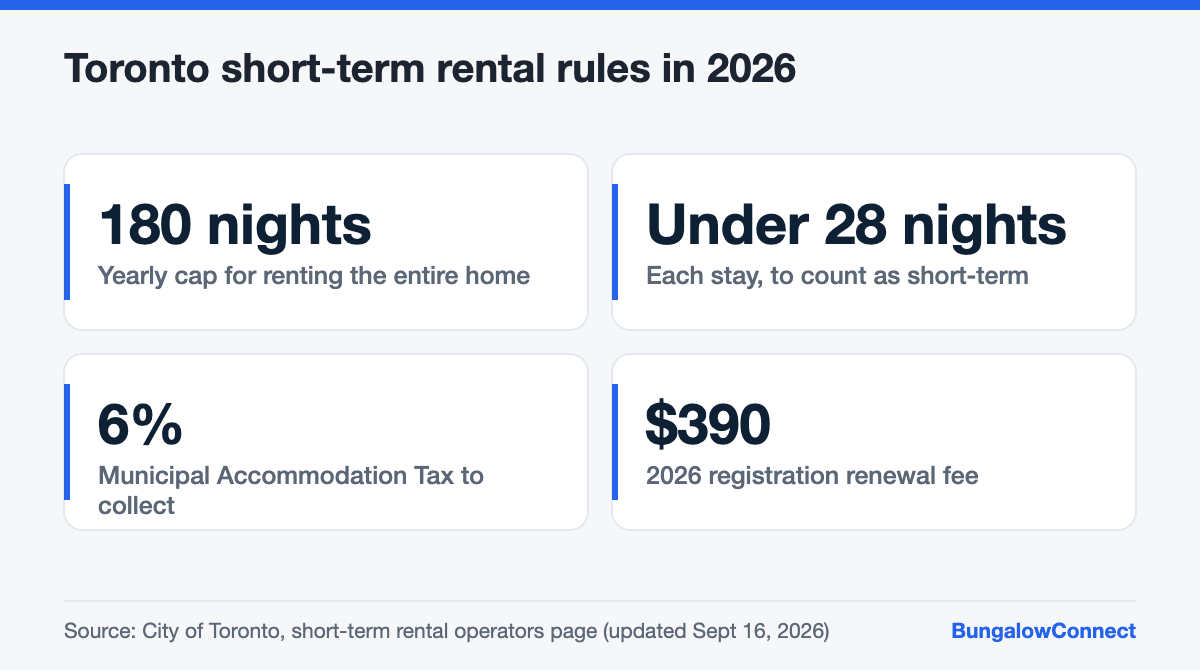
Yes, you can rent out your Toronto bungalow while you winter away, as long as it is your principal residence, you register with the city, and you rent the entire home for no more than 180 nights in a calendar year. Each stay must be under 28 nights to count as a short-term rental. Longer stays can create a tenancy under Ontario law, which is a very different arrangement.
Key takeaways
- Toronto allows short-term rentals only in the operator’s principal residence.
- Renting the entire home is capped at 180 nights per calendar year.
- A November-to-mid-April winter is about 165 nights, split across two calendar years.
- You must collect 6% Municipal Accommodation Tax and show your registration number on every listing.
- CRA denies expenses for any period a short-term rental breaks local rules.
Who can rent short-term in Toronto?
The city’s short-term rental rules (page updated September 16, 2026) are built around one idea: you can only rent out the home you live in. Your principal residence is where you live and the address you use for bills, identification, taxes and insurance. You can have only one at a time.
That works well for snowbirds. Your Toronto bungalow stays your principal residence while you spend the winter in Florida, Arizona or anywhere else, so it can be registered. A second property you own and do not live in cannot.
What about the basement suite?
The city says you can short-term rent a secondary suite only if the suite itself is your principal residence. If you live upstairs, you cannot separately rent the basement apartment short-term. Many bungalow owners with suites rent them to long-term tenants instead, which is not affected by these rules.
How the 180-night cap works for a winter away
Toronto distinguishes between two types of short-term rental, and you must pick one for each registration period:
- Entire home: the whole house, up to 180 nights per calendar year. This is the snowbird option.
- Partial home: up to three bedrooms while you live there, with no night limit. It does not apply while you are away.
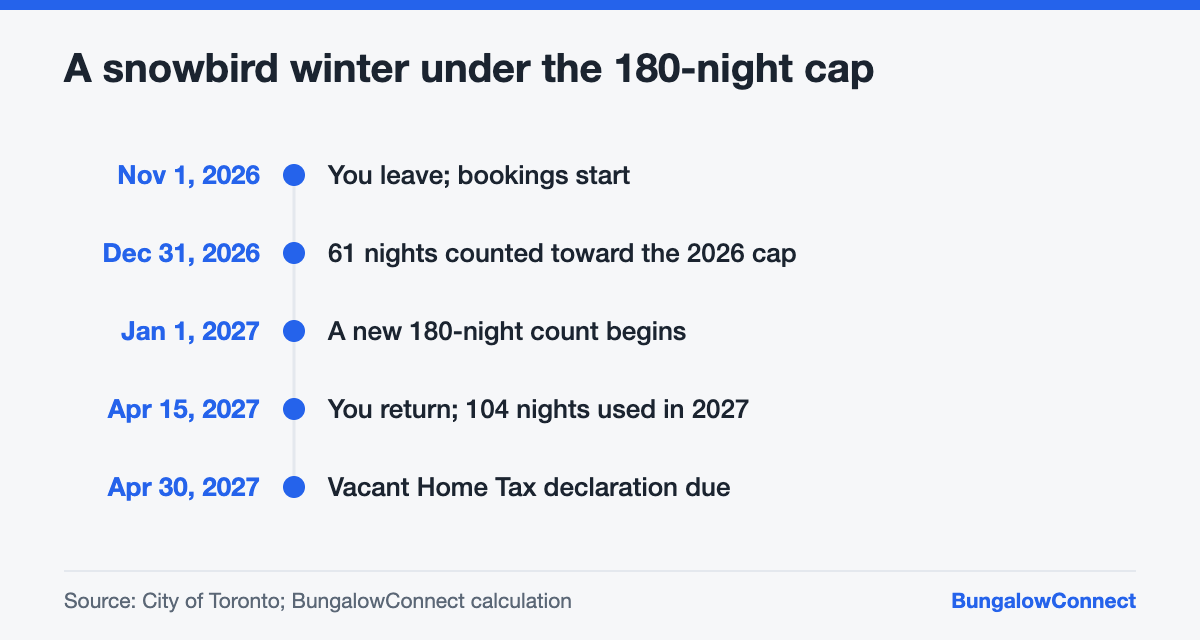
Because the cap is per calendar year, a winter away is split. If you leave on November 1, 2026 and return on April 15, 2027, that is 165 nights in total: 61 in 2026 and 104 in 2027. Neither year comes close to 180, which leaves room for a summer cottage trip as well. If you also rented the house for a few weeks last summer, count those nights against the 2026 total.
The 28-night line: short-term rental or tenancy?
Under the city’s bylaw, a short-term rental is a stay of less than 28 consecutive days. Many snowbirds would rather find one guest for the whole winter, such as a visiting professor or a family between homes. That stay is not a short-term rental, and it raises a bigger question: whether it creates a tenancy under the Residential Tenancies Act.
If it does, the guest becomes a tenant. In Ontario, a tenancy does not end automatically when a fixed term expires; it generally continues month to month unless it is ended for a reason the law allows. The Landlord and Tenant Board’s guide to the Act explains how tenancies end. Some situations are exempt from the Act, but the lines are technical. Get a lawyer’s opinion before you hand your keys to anyone for months.
| Arrangement | Main rules | Main risk |
|---|---|---|
| Series of stays under 28 nights | City registration, 180-night cap, 6% MAT | Wear and tear, management while you are away |
| One guest for 28+ nights | Possibly the Residential Tenancies Act | Guest may become a tenant you cannot easily remove |
| Family member or house-sitter, no rent | No rental rules, but tell your insurer | Fewer, as long as expectations are written down |
Registration, tax and record-keeping
- Register with the city. The 2026 renewal fee is $390 (non-refundable and subject to annual increases). Post your registration number on every ad, invoice and receipt.
- Collect and remit the 6% Municipal Accommodation Tax. On $6,000 of bookings, that is $360. File a MAT report for every period, even one with no bookings.
- Keep records of nights rented, prices and rental type for three years. The city can ask for them.
- Report the income on your tax return. CRA treats a property rented for less than 90 consecutive days as a short-term rental.
The fines are not trivial. Operating without registration, or advertising without a number, carries a $1,000 fine, and a conviction after a summons can reach $100,000 or $10,000 a day.
Tip: Bungalows are attractive to winter guests who want a house without stairs, often families visiting relatives or people recovering from surgery. If you list, describe the one-level layout, parking and snow clearing clearly, and arrange a local contact who can handle a furnace issue at 2 a.m. while you are three time zones away.
CRA rules: expenses and your principal residence
For tax years after 2023, CRA denies deductions for non-compliant short-term rentals. If your rental breaks municipal rules for part of the year (no registration, for example), the expenses for those days are not deductible, prorated by days. CRA’s own example: $60,000 of expenses with 181 non-compliant days out of 365 means $29,753 cannot be deducted. Register before your first booking.
Renting your home while you are away can also raise principal residence questions when you eventually sell. CRA’s position, in its folio on the principal residence, is that occasional income-producing use generally does not change a home’s status if the use is ancillary to living there, you make no structural changes, and you do not claim capital cost allowance. Do not claim depreciation on your home, and ask an accountant to review your situation.
Insurance, property tax and practical checks
- Insurance. A standard home policy may not cover paying guests. Ask your insurer about a home-sharing endorsement, and check the conditions for a home left without you in it, such as regular inspections or water shut-off rules. Our Ontario home insurance guide covers the basics.
- Vacant Home Tax. If the house stays empty instead, it is still your principal residence. The city’s Vacant Home Tax page says that status applies to snowbirds, but you must file the April 30 declaration. See our Vacant Home Tax exemptions guide.
- Winter readiness. Service the furnace, clean the eavestroughs and arrange snow removal. Our pre-vacation home checklist is a good start.
Frequently asked questions
Can I Airbnb my house in Toronto while I am away for the winter?
Yes, if the house is your principal residence and you register with the city. You can rent the entire home for up to 180 nights in each calendar year, in stays shorter than 28 nights, and you must collect the 6% Municipal Accommodation Tax. Check your insurance, and for condo bungalows, whether the condo rules ban short-term rentals.
Can I rent my house for three months while I travel?
You can, but a single stay of 28 nights or more is not a short-term rental under Toronto’s bylaw, and it may create a tenancy under the Residential Tenancies Act. A tenant generally does not have to leave when a fixed term ends. Get legal advice before agreeing to a long stay with one occupant.
Is short-term rental income taxable?
Yes. Report it on your tax return and deduct eligible expenses only for periods when the rental complied with local rules. CRA treats rentals of less than 90 consecutive days as short-term. Avoid claiming depreciation on your home, because that can affect your principal residence exemption when you sell.
Prefer a home that is easy to leave for the winter?
Many downsizers choose a smaller or condo bungalow because exterior maintenance is handled for them. Browse Toronto-area bungalows if a lock-and-leave home is on your list.
This article is general information as of October 2026, not legal, tax, mortgage or financial advice. Rules and numbers change, so confirm the details for your situation with a licensed professional.