Selling your house does not affect your Old Age Security if the home was your principal residence for every year you owned it, because the gain is sheltered and adds nothing to your net income. What can trigger the OAS clawback is taxable income that follows the sale: interest or dividends on the money you invest, or a taxable gain on a property that was not fully your principal residence. For 2026, the clawback starts at net income of $95,323.
Key takeaways
- A fully sheltered principal residence sale is not income, so it does not reduce OAS or count toward the clawback.
- You must still report the sale on Schedule 3 and Form T2091 of your tax return.
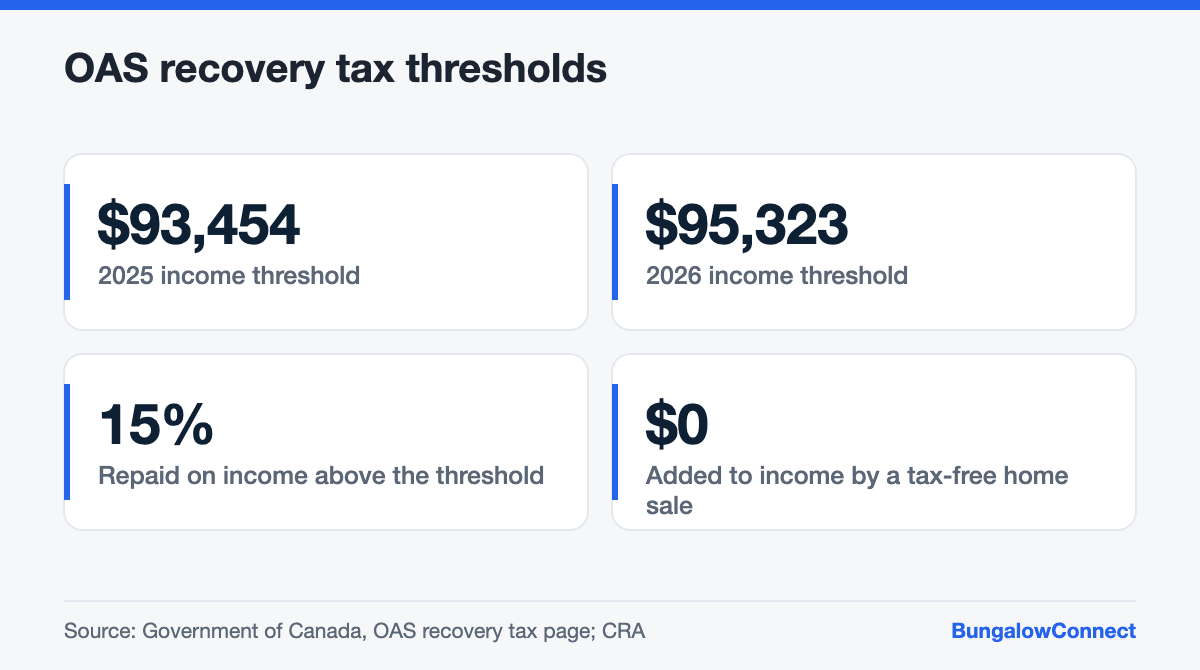
- The OAS recovery tax is 15% of net income above $93,454 for 2025 and $95,323 for 2026.
- Interest on invested sale proceeds counts as income; money held in a TFSA does not.
- A home with a rented suite, or a cottage you also own, can produce a taxable gain in the year of sale.
Why a home sale does not count as income
The principal residence exemption shelters the capital gain on the home you ordinarily lived in, for the years you designate it. If your house qualified for every year you owned it, the gain is fully exempt. Exempt gains are not included in net income, which is the number the OAS clawback is based on.
You still have to report the sale. CRA’s principal residence folio says every disposition must be reported on Schedule 3 of the return, with Form T2091(IND) used to make the designation. Skipping it can cause problems later.
How the OAS clawback works in 2026
The clawback is officially the OAS pension recovery tax. According to the Government of Canada’s recovery tax page, you repay 15% of the amount by which your net income exceeds the threshold for the year.
| Income year | Minimum threshold | Repaid from your OAS during |
|---|---|---|
| 2024 | $90,997 | July 2025 to June 2026 |
| 2025 | $93,454 | July 2026 to June 2027 |
| 2026 | $95,323 | July 2027 to June 2028 |
The government’s own example: with 2025 income of $100,000, you are $6,546 over the threshold and repay 15% of that, or $981.90, from July 2026 to June 2027. At much higher incomes, OAS is eliminated entirely; for ages 65 to 74 in 2026 the government lists that point at about $155,300.
What can trigger the clawback after you downsize
1. Income from the money you free up
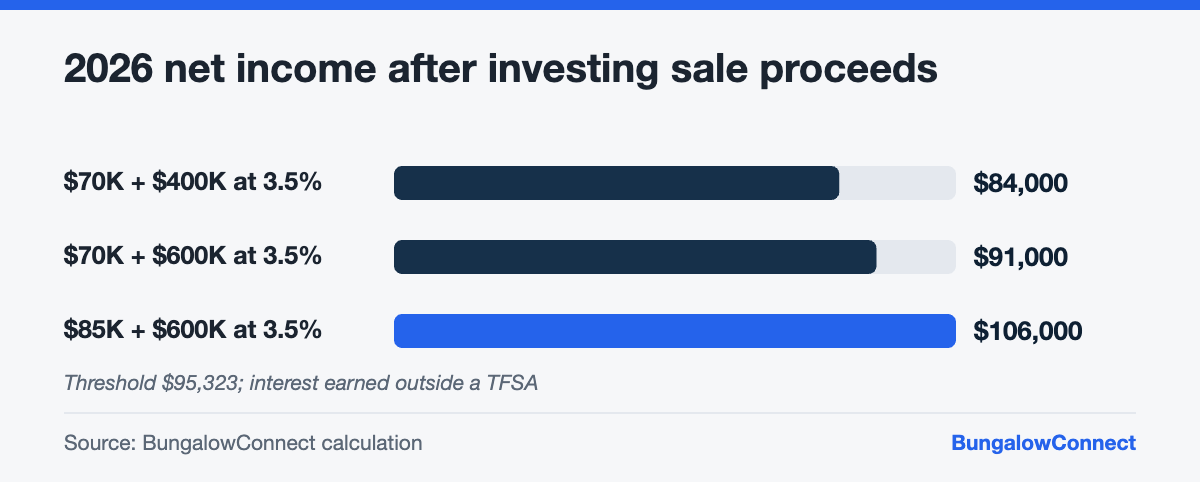
This is the big one. Say you sell a family home and buy a bungalow for less, leaving a few hundred thousand dollars to invest. Interest from GICs or savings, dividends and realized capital gains in a non-registered account all count toward net income every year. We modelled three retirees investing at an illustrative 3.5% interest rate in 2026:
| Other 2026 income | Proceeds invested | Interest at 3.5% | Net income | Clawback |
|---|---|---|---|---|
| $70,000 | $400,000 | $14,000 | $84,000 | $0 |
| $70,000 | $600,000 | $21,000 | $91,000 | $0 |
| $85,000 | $600,000 | $21,000 | $106,000 | $1,601.55 |
In the third case, income is $10,677 over the 2026 threshold, so 15% of that, $1,601.55, would be recovered from OAS payments between July 2027 and June 2028. Income in a TFSA does not count toward net income, which is why TFSA room is worth asking your advisor about before you invest the proceeds.
2. A home that was not fully your principal residence
- A rented basement suite. If you created a self-contained rental unit, the suite’s share of the gain since then may be taxable. We explain how in capital gains on a bungalow with a rented basement.
- Two properties. Only one property per family unit can be designated for each year. If you own a city house and a cottage, designating one leaves the other’s gain partly taxable.
- Years you lived elsewhere. Periods when the house was rented out entirely, or you were not resident in Canada, can reduce the exemption.
Half of any taxable capital gain is added to income in the year of sale, since the inclusion rate remains one-half after the proposed increase was cancelled in March 2025. One large taxable gain can push income far over the threshold for that single year.
3. Selling a rental or second property at the same time
Some downsizers sell a rental property or cottage in the same year as the family home. If those gains are taxable, the timing of each sale can change how much OAS you keep. Spreading sales across calendar years is sometimes worth modelling with an accountant.
Tip: If part of your gain will be taxable, look at the closing date. A sale that closes on January 5 instead of December 28 falls into the next tax year, which can matter if that year’s income will be lower. Bungalow buyers and sellers can usually agree on a closing date a week or two either side, so raise it before you sign.
What about GIS and other benefits?
The Guaranteed Income Supplement is also income-tested, at much lower income levels than the OAS clawback. A tax-free principal residence sale does not count, but interest on the proceeds does. If you receive GIS, a sudden increase in investment income can reduce it the following benefit year, so plan where the money goes before you close.
A downsizing checklist for OAS recipients
- Confirm the house qualifies as your principal residence for every year, and gather the purchase date and price.
- Report the sale on Schedule 3 and Form T2091 for the year it closes.
- Estimate the income your leftover proceeds will produce and compare it to the threshold.
- Ask a licensed advisor about registered options such as a TFSA and about whose name the money is invested in.
- If any gain is taxable, think about the closing date and other sales that year.
For the property side of the decision, see our guide to downsizing in a down market and our empty nester’s guide to bungalows. If a lower-cost option appeals, our look at land lease communities explains the trade-offs.
Frequently asked questions
Does the sale of a principal residence count as income for OAS?
No, as long as the home qualified as your principal residence for all the years you owned it. The exempt gain is not included in net income, so it does not affect OAS or the clawback. You must still report the sale and designation on Schedule 3 and Form T2091 of that year’s return.
What is the OAS clawback threshold for 2026?
For the 2026 income year, the minimum threshold is $95,323 of net income, according to the Government of Canada. If your income is higher, 15% of the excess is recovered from OAS payments between July 2027 and June 2028. For 2025 income, the threshold is $93,454, recovered from July 2026 to June 2027.
Will interest on my house sale money reduce my OAS?
It can. Interest, dividends and realized capital gains earned in a regular account count toward net income each year. If that income pushes you over the threshold, part of your OAS is recovered. Income earned inside a TFSA does not count, so speak with a licensed advisor about how to hold the proceeds.
Planning your next home?
See what your current home could sell for with a free home value estimate, then browse bungalows under $1 million to see how much you could free up.
This article is general information as of October 2026, not legal, tax, mortgage or financial advice. Rules and numbers change, so confirm the details for your situation with a licensed professional.