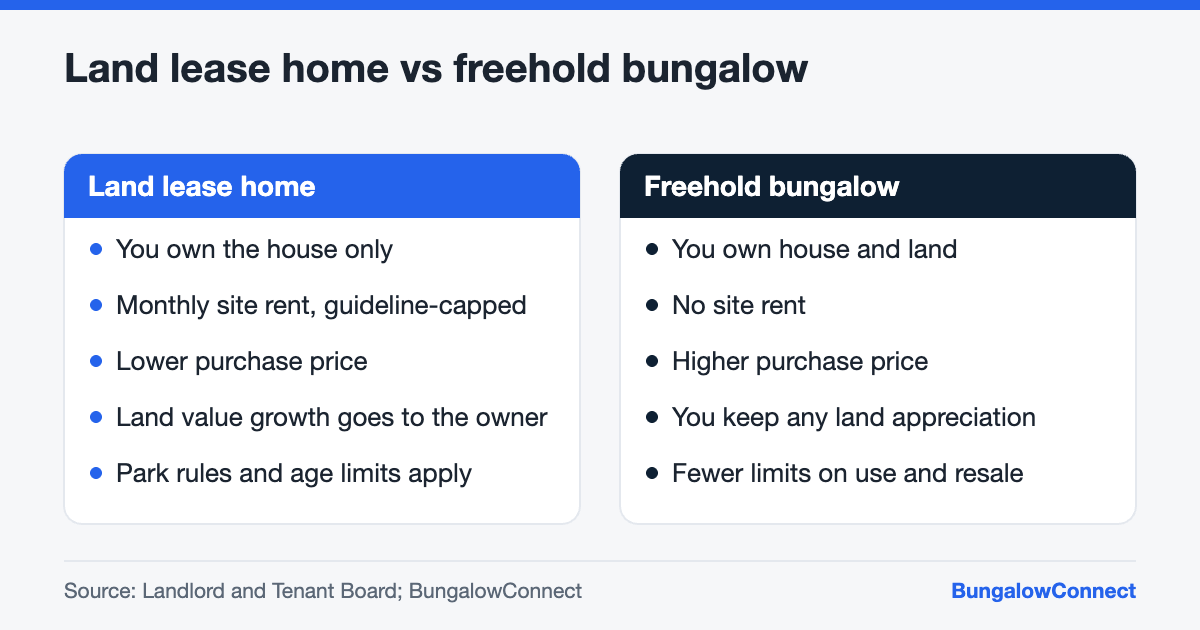
In an Ontario land lease community, you buy and own the house but rent the land it sits on, paying a monthly site fee to the community owner. That is why land lease bungalows in 55+ communities often list well below nearby freehold homes. The trade-off is ongoing rent, park rules, and the fact that land appreciation, usually the biggest driver of home values, goes to the landowner rather than to you.
Key takeaways
- You own the home; the land is leased, and the site rent is covered by Ontario’s Residential Tenancies Act.
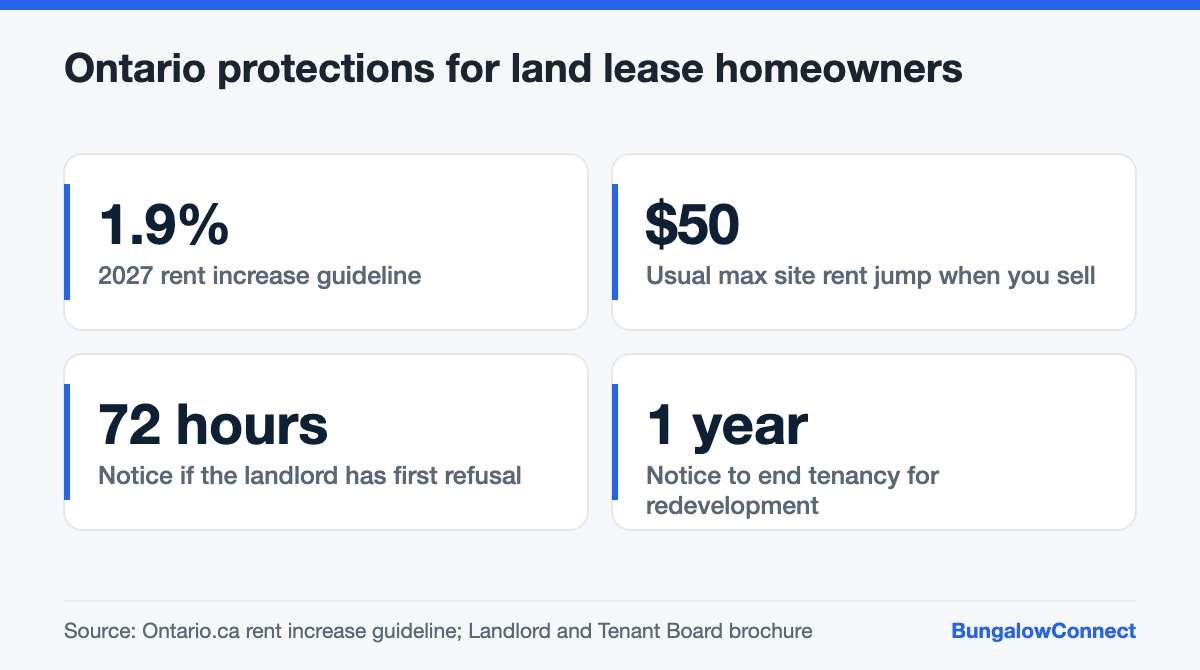
- Annual site rent increases are capped by the provincial guideline: 2.1% for 2026 and 1.9% for 2027.
- You have a legal right to sell, and a buyer who takes over your site usually faces at most a $50 rent increase.
- Financing can be harder than for freehold homes, so speak to a lender before you offer.
- Compare the total monthly cost and the resale pool, not just the purchase price.
What is a land lease community?
A land lease community is a planned neighbourhood where one owner (often a company) owns all the land and the roads, clubhouse and amenities, while residents own their individual homes. In Ontario many of these communities are adult lifestyle communities for people 55 and over, and the homes are typically bungalows: one-storey living, small yards and little exterior upkeep.
A well-known example is Sandycove Acres in Innisfil, which local listing material describes as Ontario’s first and largest 55+ adult lifestyle land lease community, with clubhouses, pools and walking trails on roughly 300 acres. Similar communities exist in cottage country and along the lakeshore east and west of the GTA.
Do not confuse land lease with a life lease, which is a different arrangement usually sponsored by a non-profit, or with a condo bungalow, where you own your unit and a share of the common property outright.
Your rights under the Residential Tenancies Act
Because you rent the land, the Residential Tenancies Act applies to your site, with special rules for mobile home parks and land lease communities. The Landlord and Tenant Board’s brochure on land lease communities sets them out. The ones that matter most to buyers:
- Right to sell. You have the right to sell a land lease home you own. The landlord cannot insist on acting as your agent unless you agree in a separate written agreement.
- Right of first refusal. A lease can give the landlord the first chance to buy, but you must only give 72 hours’ notice of an acceptable offer, and a clause letting the landlord buy for less than a third party’s offer is void.
- Assigning the site to your buyer. The landlord cannot refuse without the Board’s permission and must apply within 15 days of your request. Otherwise the assignment is treated as approved.
- Rent on resale. When you sell and assign the tenancy, the landlord in most cases cannot raise the rent by more than $50 above what you paid.
- Park rules in writing. The landlord must give you the rules and notify you in writing of changes.
How much can site rent go up?
Site rent rises by up to the annual rent increase guideline, which ontario.ca lists as 2.1% for 2026 and 1.9% for 2027, without Board approval. On $900 a month, a 1.9% increase is about $17.10. Above-guideline increases need the Board’s approval; for major repairs or improvements, the Board generally allows up to 3% above the guideline per year for up to three years.
The real cost: price plus site rent
A lower purchase price is only half the comparison. Here is an illustration with round, hypothetical numbers: a land lease bungalow at $450,000 with $900 a month in site rent, against a freehold bungalow nearby at $800,000.
| Item | Land lease home | Freehold bungalow |
|---|---|---|
| Purchase price | $450,000 | $800,000 |
| Site rent, first year | $10,800 | $0 |
| Site rent over 10 years at 2% a year | About $118,300 | $0 |
| Interest the $350,000 difference could earn at 3.5% | About $12,250 a year (taxable) | Not available |
| Who gains from land appreciation | Community owner | You |
In this example, the interest on the money you save roughly covers the site rent at first. Over time, the rent rises with the guideline, and the freehold owner keeps any growth in land value. Your own numbers will differ, but run them both ways before you decide.
Ask what the monthly fee includes. Communities often bundle a share of property tax, water, garbage or amenity costs into the monthly charges, and one local listing source for Sandycove Acres quotes combined monthly charges of roughly $800 to $1,200 depending on the home and lot. Get the current figure in writing from the community, not from a listing.
Tip: Ask the community for the site rent history on the specific lot you are buying, and for a copy of the park rules, before you firm up. Rules on pets, guests, renting your home and exterior changes vary a lot, and they matter more to a retiree than the clubhouse brochure suggests.
Financing a land lease bungalow
Lenders treat land lease homes differently because the borrower does not own the land. A Ratehub article (from 2016, so treat it as background) reported that some lenders asked for 25% to 30% down and that CMHC would insure most land lease mortgages. Policies change, so ask a mortgage agent who has closed land lease deals in that community. Many downsizers buy with cash from the sale of a larger home, which removes the issue, but plan for the next buyer: if your buyer cannot get financing easily, your pool of buyers shrinks.
If you do need a mortgage, get pre-approved with the specific community named, and hold a rate while you shop. Our guide to mortgage rate holds explains how.
Questions to ask before you buy
- What is the current site rent, what does it include, and how has it changed over the past five years?
- Are there any above-guideline increase applications pending or approved?
- Does the landlord have a right of first refusal, and does it act as a sales agent?
- What are the age, pet, guest and rental rules?
- Who maintains roads, water, sewer and amenities, and what is their condition?
- How many homes sold in the past year, at what prices, and how long did they take?
A real estate lawyer should review the lease and rules before your conditions expire. See our guide to finding a good real estate lawyer.
Is a land lease home right for you?
It can be a good fit if you want one-level living, a social community and lower up-front cost, and you value the cash freed up more than future land appreciation. It is a weaker fit if you want to leave the property’s full value to your heirs, plan to rent it out, or want freedom from park rules. If the reason you are looking is that freehold bungalows feel out of reach, our article on the downsizing squeeze covers other options, including condo bungalows.
Frequently asked questions
Do you own the land in a land lease community?
No. You own the home, and the community owner owns the land, roads and amenities. You pay monthly site rent for your lot. In Ontario, that site tenancy is covered by the Residential Tenancies Act, so increases are capped by the annual guideline and you have specific rights when you sell your home.
Can a land lease community raise the rent when I sell?
Only in a limited way. According to the Landlord and Tenant Board, when you sell your home and assign the site to the buyer, the landlord in most cases cannot raise the rent by more than $50 above what you were paying. Normal annual guideline increases then continue under the new owner.
Are land lease homes a good investment?
They are better viewed as a lifestyle purchase than an investment. Because you do not own the land, you do not benefit from rising land values, which drive most home price growth in Ontario. Resale depends on a smaller pool of eligible buyers, so prices can move differently from the freehold market.
Can I rent out my land lease home?
Possibly. The Board’s brochure says you can rent the home but must sublet the site, which needs the landlord’s consent; the landlord cannot refuse without good reason or charge you for consenting. Community rules may also restrict rentals, especially in 55+ communities, so read them first.
Explore one-level living near the lake
Compare land lease options with freehold homes on our Innisfil bungalows page, or browse across Simcoe County for more choice.
This article is general information as of October 2026, not legal, tax, mortgage or financial advice. Rules and numbers change, so confirm the details for your situation with a licensed professional.