To sell an inherited bungalow in Ontario, the estate trustee usually needs authority from the court (a Certificate of Appointment of Estate Trustee), the estate pays estate administration tax of $15 per $1,000 of value above $50,000, and any change in value between the date of death and the sale is the estate’s gain or loss for tax purposes. If the bungalow was the deceased’s principal residence, the gain up to the date of death is generally sheltered.
Key takeaways
- A bungalow owned jointly with right of survivorship usually passes to the survivor outside the estate.
- Estate administration tax on a $1.2 million estate with no mortgage is $17,250.
- A date-of-death appraisal sets the estate’s starting value for tax and is worth paying for.
- An empty house needs immediate insurance attention, and in Toronto, a Vacant Home Tax declaration.
- In a balanced market, a well-prepared estate bungalow still sells close to list.
Who can sell the house?
It depends on how the bungalow was owned. If the deceased owned it jointly with a spouse or child as joint tenants, ownership generally passes to the survivor automatically, and the house is not part of the estate. If it was owned alone, or as tenants in common, it forms part of the estate and the estate trustee (the executor named in the will) deals with it.
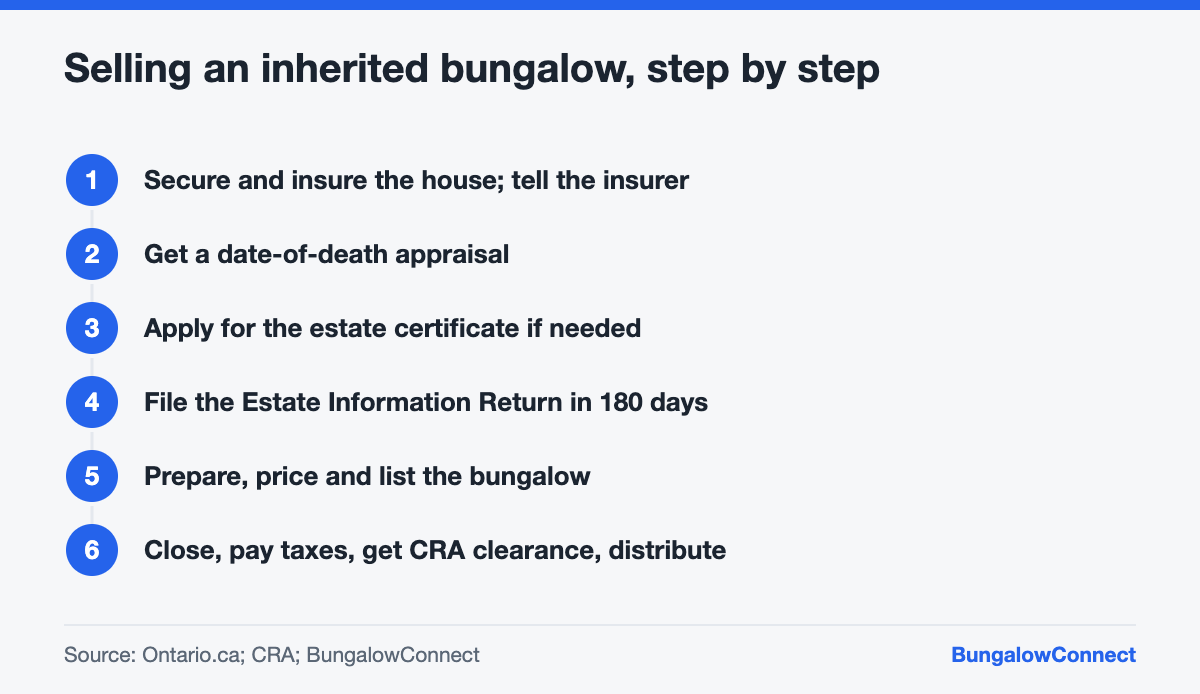
For most real estate sales, the land registry and the buyer’s lawyer will expect the trustee to have a Certificate of Appointment of Estate Trustee, often called probate. Getting it takes time, so many trustees prepare the house while the application is processed and set a closing date that leaves room for it. Your estate lawyer will tell you when it is safe to list. Our guide on why you need a lawyer to close covers the closing side.
How much is estate administration tax in Ontario?
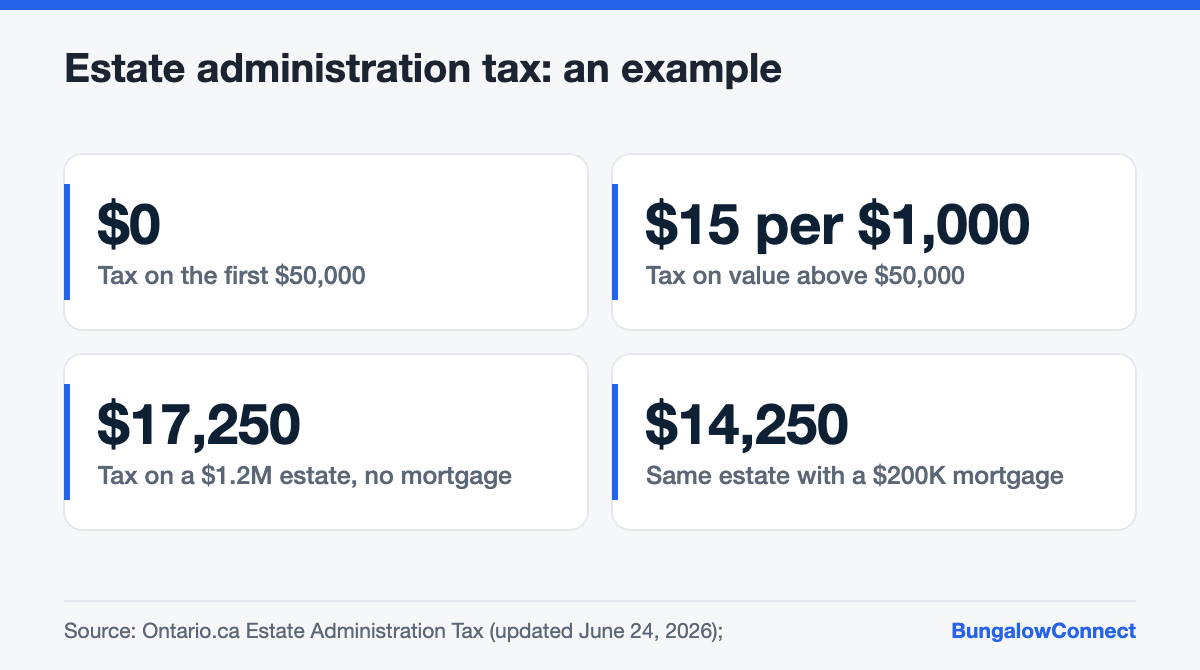
Ontario’s estate administration tax (page updated June 24, 2026) works like this:
- Estates of $50,000 or less pay no tax, though a return is still required.
- Above $50,000, the tax is $15 for each $1,000 or part of $1,000. The value is rounded up to the next thousand.
- Ontario real estate counts at its value less encumbrances, such as a mortgage or lien registered on it. Other debts, such as lines of credit and credit cards, cannot be deducted.
- The trustee must file an Estate Information Return within 180 calendar days after the certificate is issued.
| Estate | Value for tax | Estate administration tax |
|---|---|---|
| Bungalow $1,050,000 (no mortgage) plus $150,000 other assets | $1,200,000 | $17,250 |
| Same, with a $200,000 mortgage on the bungalow | $1,000,000 | $14,250 |
| Bungalow held in joint tenancy with a surviving spouse | Not in the estate | $0 on the house |
Capital gains when you sell an inherited house
When someone dies, they are generally treated for tax purposes as having sold their property at fair market value immediately before death. If the bungalow was their principal residence for every year they owned it, the gain up to that point is usually fully sheltered by the principal residence exemption, which is claimed on the final return. CRA’s principal residence folio explains the designation, which is reported on Schedule 3 and Form T2091.
After death, the estate’s cost is that date-of-death value. Anything the house gains or loses until it is sold belongs to the estate. Two examples, using a date-of-death value of $1,050,000:
| Sale result | Net after $45,000 to $47,000 costs | Estate’s capital gain or loss |
|---|---|---|
| Sold for $1,080,000, 14 months later | $1,035,000 | Loss of $15,000 |
| Sold for $1,120,000 | $1,073,000 | Gain of $23,000 ($11,500 taxable) |
In a falling market, an estate can end up with a loss. In some cases a loss realized in the estate’s first year can be applied back to the deceased’s final return. Ask the estate’s accountant before the sale closes, because timing matters.
Tip: Order the date-of-death appraisal from an accredited appraiser as soon as you can, even if you plan to sell quickly. It protects the estate if CRA questions the value, it settles arguments between siblings, and it gives you a realistic starting point for pricing. With GTA detached benchmarks down about 5% over the past year, a value from last spring may already be stale.
Looking after an empty bungalow while you wait
- Insurance. Tell the insurer about the death right away. Many policies have conditions for unoccupied homes, such as regular inspections or draining the plumbing in winter. A claim on a house nobody told the insurer was empty can be refused.
- Winter. Keep the heat on, shut off the main water valve if no one is checking daily, and arrange snow clearing so the house does not look abandoned.
- Toronto’s Vacant Home Tax. An estate still has to declare by April 30. The death exemption can be claimed for up to three consecutive years. See our guide to Vacant Home Tax exemptions.
- Utilities and mail. Keep utilities in the estate’s name, and forward mail to the trustee.
Preparing an estate bungalow for sale
Estate bungalows are often well built and well kept, but dated: original kitchens, older windows, sometimes original wiring. Buyers expect this. The question is how much to do before listing.
- Clear it completely. An empty, clean house shows better than one full of a lifetime of furniture. Our room-by-room decluttering plan helps when emotions are running high.
- Fix only what scares buyers. A leaking roof, a damp basement or an outdated electrical panel will show up on inspection and cost you more in negotiation than to repair.
- Skip the big renovation. A full kitchen redo rarely pays back on an estate sale, and buyers of older bungalows often plan to renovate to their own taste.
- Stage lightly. A few pieces of furniture help buyers judge room sizes. See our bungalow staging tips.
Estate sellers often know little about the home’s history, and agreements commonly say so. Buyers will rely on their own inspection, so gather what records you can: permits, roof and furnace dates, and any survey.
When to list in today’s market
TRREB’s September 2026 numbers showed GTA homes selling at 98% of list in an average of 34 days, with about 4.6 months of inventory. That is a balanced market. A clean, well-priced estate bungalow does not need to wait for spring, and carrying costs (tax, insurance, utilities, and possibly the Vacant Home Tax) add up every month it sits.
If one beneficiary wants to buy the house, get the appraisal first and have the lawyer document the price. It avoids disputes later. To see what similar bungalows have sold for, check our recent sold bungalows.
Frequently asked questions
Do you have to pay tax when you sell an inherited house in Ontario?
Possibly a little. If the house was the deceased’s principal residence, the gain up to the date of death is usually sheltered. Any increase between the date of death and the sale is a capital gain to the estate, and half of it is taxable. If the house drops in value instead, the estate has a capital loss.
Can an executor sell a house before probate in Ontario?
An executor can prepare and market the house, but most buyers’ lawyers and the land registry will require a Certificate of Appointment of Estate Trustee before closing when the house is in the estate. Trustees often set a longer closing date to allow for it. Your estate lawyer can confirm whether probate is needed in your case.
How is estate administration tax calculated on a house?
The house is included at its fair market value at the date of death, less any mortgage or lien registered on it. The total estate value is rounded up to the next $1,000, the first $50,000 is tax-free, and the rest is taxed at $15 per $1,000. Other debts cannot be deducted.
How long can an inherited house sit empty?
There is no legal limit, but costs and risks grow. Insurance conditions for unoccupied homes can be strict, especially in winter. In Toronto, the Vacant Home Tax death exemption lasts up to three consecutive years, after which an empty house can be taxed at 3% of its assessed value.
Get a realistic value for the estate
Start with a free bungalow value estimate, then talk to us through our sellers page about timing and preparation.
This article is general information as of October 2026, not legal, tax, mortgage or financial advice. Rules and numbers change, so confirm the details for your situation with a licensed professional.