
You may pay capital gains tax on part of the profit when you sell a bungalow with a rented basement, but only if the suite changed how CRA views the property. Renting rooms without structural changes, and without claiming depreciation, generally keeps the whole house as your principal residence. Building a self-contained apartment usually creates a “change in use” for that share of the house, and growth on that share after the change can be taxable.
Key takeaways
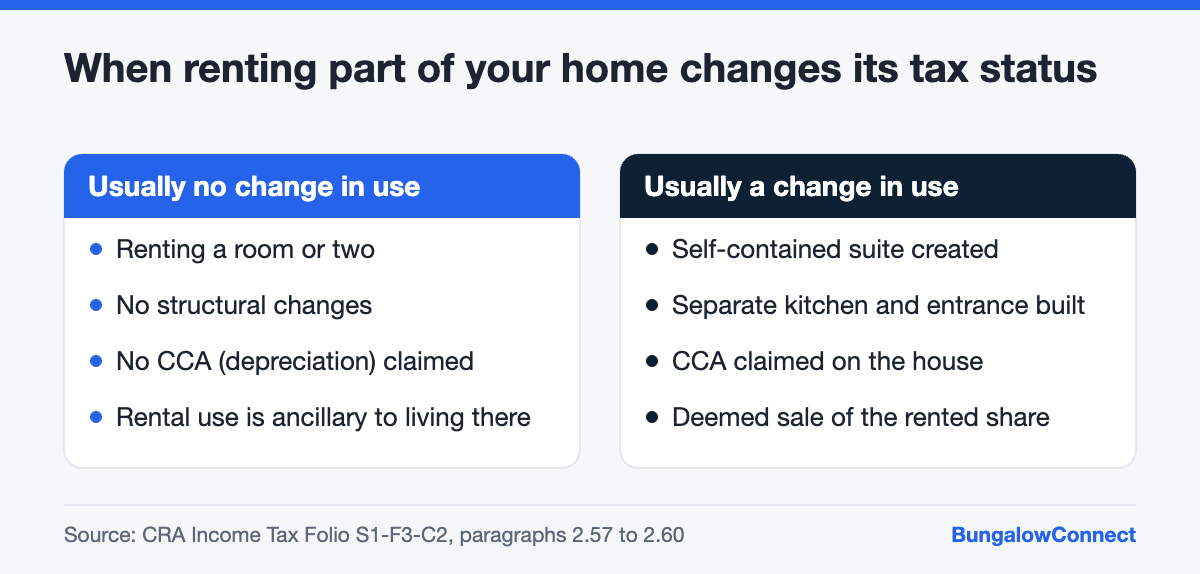
- CRA lets the whole home stay a principal residence if the rental is ancillary, there is no structural change and no CCA is claimed.
- Converting part of the house into a self-contained rental unit is CRA’s own example of a change in use.
- A change in use is a deemed sale of the rented share at fair market value, usually measured by floor area.
- Claiming CCA (depreciation) on the house is the easiest way to lose the exemption on the suite.
- The capital gains inclusion rate is still one-half; the proposed increase was cancelled in March 2025.
Why this matters more in a bungalow
In a two-storey house, a basement apartment might be a quarter of the finished space. In a bungalow, the basement has the same footprint as the main floor. A full basement apartment can be close to half the home’s finished area, which means a larger share of your eventual gain is exposed if the suite triggers a change in use.
Bungalows are also the house type most often bought with a suite already in place, or converted into two units for income. If that describes your home, the tax side deserves as much attention as the rent.
What CRA says about renting part of your home
CRA sets out its position in Income Tax Folio S1-F3-C2, Principal Residence. The key paragraphs are short:
- Paragraph 2.57: converting part of a home to income-producing use is generally a deemed disposition of the converted portion, usually based on floor area, followed by a deemed reacquisition at the same value.
- Paragraph 2.58: this applies where the change is substantial and more permanent, “that is, where there is a structural change.” Its example is converting part of a house into a self-contained rental unit.
- Paragraph 2.59: as a practice, CRA treats the whole property as keeping its principal residence status when the income-producing use is ancillary, there is no structural change, and no CCA is claimed.
- Paragraph 2.60: renting rooms, a home daycare and a home office are typical examples of ancillary use. If you later start claiming CCA, the deemed disposition applies from the date the rental began.
Three common bungalow scenarios
| Scenario | Likely treatment | What to watch |
|---|---|---|
| You rent a basement bedroom to a student, sharing the kitchen | Ancillary use; whole house generally stays your principal residence | Do not claim CCA; report the rent |
| You built a self-contained basement apartment in an existing bungalow | Change in use for the suite’s share when the conversion happened | Get a fair market value estimate at the conversion date; consider the 45(2) election |
| You bought a bungalow that already had a rented suite | The rented unit was never part of your home | Expect the rented share’s gain to be taxable on sale |
These are general patterns. The facts of your home, such as how separate the unit is and whether family members live there, can change the answer.
Worked example: a suite created in 2015
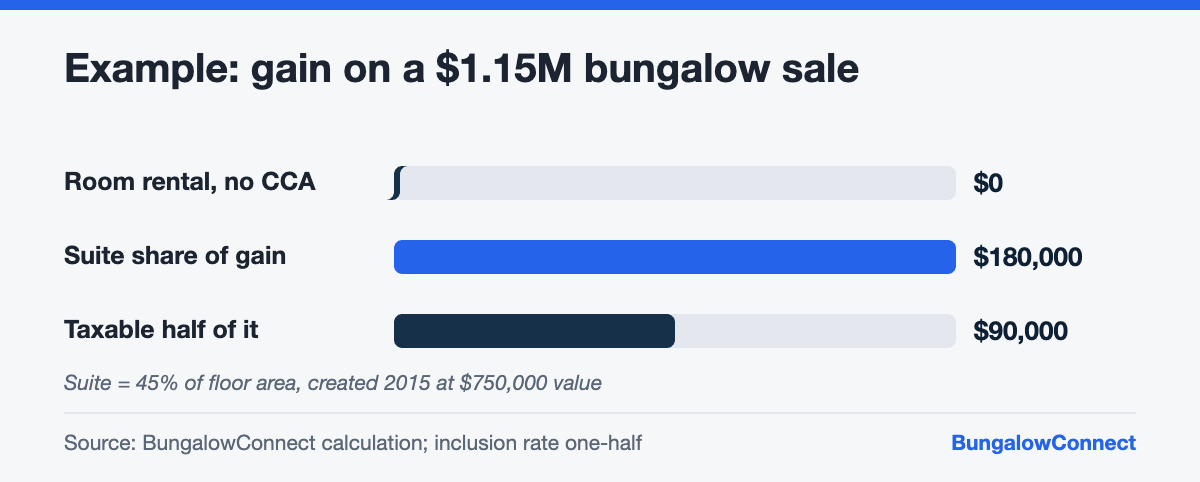
Say you bought a bungalow in 2008 for $450,000 and lived in it. In 2015, when it was worth $750,000, you finished the basement as a self-contained apartment with its own kitchen and entrance, and rented it out. The suite is 45% of the home’s floor area. You sell in 2026 for $1,150,000.
- 2015 change in use. The suite’s 45% share is deemed sold at its $750,000 value. The gain up to 2015 is covered by the principal residence exemption, because the whole house was your home until then.
- Growth after 2015. The house rose $400,000 from 2015 to 2026. The suite’s 45% share of that is $180,000.
- Taxable amount. With a one-half inclusion rate, $90,000 is added to your taxable income in the year of sale, before selling costs and other adjustments.
Your main-floor share (55%) remains your principal residence and its gain is sheltered. Had you instead rented a room with no structural change and no CCA, the whole gain would generally be sheltered.
Tip: If you are about to convert a bungalow basement into a suite, ask a real estate appraiser for a dated fair market value letter the month the tenant moves in. If CRA ever asks how you calculated the change-in-use value, a contemporaneous appraisal is far stronger than a guess made ten years later.
The 45(2) election for a partial change in use
Since March 19, 2019, CRA’s folio says you can elect under subsection 45(2) so that the deemed disposition does not apply when you convert part of your home to a rental. You make the election by letter, filed with your tax return for the year of the change.
The election defers the deemed sale; it does not make the rented space your home. When you eventually sell, how much of the gain is sheltered depends on your designation years and the facts. CCA also interacts with the election: claiming it can undo the benefit. This is a place to model the numbers with an accountant rather than guess.
CCA: the shortcut that costs you later
CCA is depreciation on the building. Claiming it on a suite can reduce the tax on your rental income today, but CRA’s folio is clear that claiming CCA is one of the three things that ends ancillary-use treatment. It can also create recapture (previously deducted depreciation added back to income) when you sell. Most owner-occupiers with a basement suite are better off deducting ordinary expenses, such as a share of utilities, insurance, property tax and repairs, and leaving CCA alone.
Reporting the sale
Every sale of a principal residence must be reported on Schedule 3 of your return, with Form T2091(IND) to designate the years. Only one property per family unit can be designated for each year. If part of the house was a rental, your accountant will split the proceeds and report the taxable share. Keep the records that make that split defensible:
- Floor area measurements of the suite and the rest of the house.
- The date the suite was created and any fair market value evidence from then.
- Your rental income filings (Form T776) for every year it was rented.
- Permits and invoices for the conversion work.
Also remember HST. Building a new self-contained unit can bring its own tax issues, which we cover in the HST surprise on garden suites. If you are weighing a suite for qualifying purposes, see whether suite rent helps you qualify for a mortgage, and for the overall strategy, house hacking with an Ontario bungalow.
Frequently asked questions
Do I pay capital gains if I rent out my basement?
Not necessarily. If you rent space without structural changes, the rental is ancillary to living there, and you claim no CCA, CRA generally treats the whole house as your principal residence. If you created a self-contained apartment, the suite’s share of the gain after the conversion may be taxable when you sell.
How does CRA calculate the rented portion of a house?
CRA’s folio says the converted portion is usually measured by area. In practice, accountants compare the suite’s floor area to the home’s total finished area, then apply that percentage to the gain after the change in use. Keep measurements and a dated value estimate, because both numbers can be questioned years later.
Can I avoid capital gains on a duplex I live in?
Generally only on the part you live in. The unit you occupy can be designated as your principal residence; the rented unit is an income property. The 45(2) election can defer the deemed sale when you convert part of your existing home, but it does not shelter the rented unit forever.
Did the capital gains inclusion rate change in 2026?
No. The federal government cancelled the proposed increase to a two-thirds inclusion rate on March 21, 2025, so the rate for individuals remains one-half. Half of a taxable capital gain is added to your income and taxed at your marginal rate in the year of sale.
Selling a two-unit bungalow?
Buyers price income bungalows differently from single-family homes. Start with a home value estimate, and talk to your accountant before you list, not after you accept an offer.
This article is general information as of October 2026, not legal, tax, mortgage or financial advice. Rules and numbers change, so confirm the details for your situation with a licensed professional.