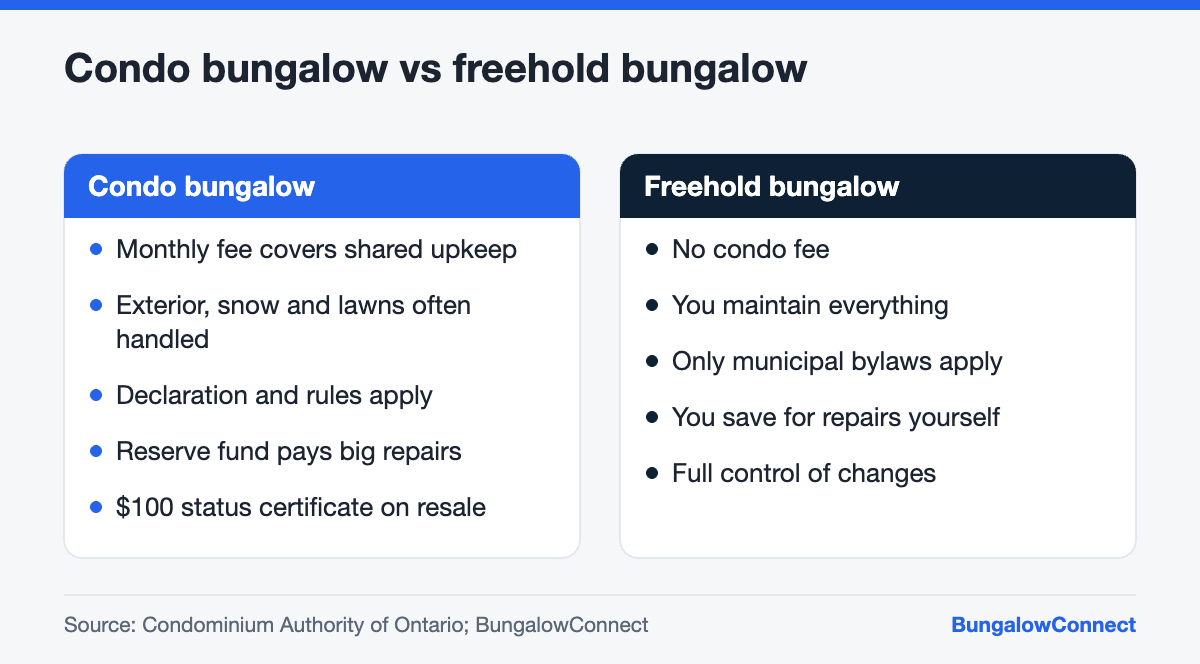
A condo bungalow gives you one-level living with much of the outdoor work done for you, in exchange for a monthly fee and the condo corporation’s rules. A freehold bungalow has no fee and no shared decisions, but every roof, driveway and snowfall is yours to handle. A POTL (parcel of tied land) sits in between: you own your house and lot freehold, tied to a condo that owns shared roads or amenities.
Key takeaways
- Condo fees fund shared maintenance and a reserve fund for major repairs.
- A resale condo status certificate costs no more than $100 and must be delivered within 10 days.
- POTL owners own their lot but pay a fee for shared elements such as private roads.
- New condos have a 10-day cooling-off period; new freehold homes get one from January 1, 2027.
- Condo rules can restrict pets, rentals, short-term rentals and exterior changes.
The three ways to own a bungalow
| Type | What you own | Monthly fee | Who maintains the exterior |
|---|---|---|---|
| Standard condo bungalow townhouse | Your unit; a share of common elements | Yes, usually the highest of the three | Often the corporation, depending on the declaration |
| POTL (freehold tied to a common elements condo) | Your house and lot, freehold | Yes, for shared roads or amenities | Usually you |
| Freehold bungalow or bungalow townhouse | Your house and lot | No | You |
Which category a listing falls into is not always obvious from photos. Bungalow townhouses can be any of the three. Ask the listing agent, and have your lawyer confirm it from title and the condo documents.
What condo fees cover, and what they do not
Every condo is governed by its declaration, by-laws and rules. Depending on the declaration, the fee might cover exterior maintenance, roofs, windows, landscaping, snow removal, garbage, common area utilities, building insurance, management and the reserve fund. It almost never covers your own property tax, your unit’s utilities or your contents insurance.
The reserve fund is the part buyers should study most. It is the condo’s savings account for big repairs, such as roofs and paving. A healthy fund means fewer surprises. A thin one can mean a special assessment, an extra bill shared among owners. The Condominium Authority of Ontario’s condominium buyers’ guide explains how this works.
Rules that matter to downsizers
- Pets: number, size or type limits.
- Rentals: leasing restrictions, and many condos ban short-term rentals.
- Exterior changes: doors, windows, decks, colours and even plantings may need approval.
- Age: some adult lifestyle communities have occupancy rules.
If you plan to winter away and rent the home, check the rules first. Our guide to renting your bungalow while you winter away covers the city side.
The status certificate: your best due diligence tool
For a resale condo, including a condo bungalow townhouse, the status certificate tells you about the corporation’s finances, reserve fund, legal actions, insurance and any known special assessments. According to the Condominium Authority of Ontario (page updated July 24, 2026), the fee is capped at $100 including taxes and the corporation must deliver it within 10 days. A rush fee is allowed only if the standard $100, 10-day option is also offered.
Make your offer conditional on your lawyer’s review of the status certificate. For a POTL, ask your lawyer which condo documents apply to the shared elements.
Tip: When you compare a condo bungalow with a freehold one, add the condo fee to the freehold home’s expected maintenance, not to its purchase price. A freehold bungalow still needs a roof, a driveway and snow clearing; the condo fee may simply be paying for those on a schedule. Compare the full yearly cost of both.
Buying new: deposit protection and cooling-off rules
New condo bungalows and new freehold bungalow townhouses are covered by different rules:
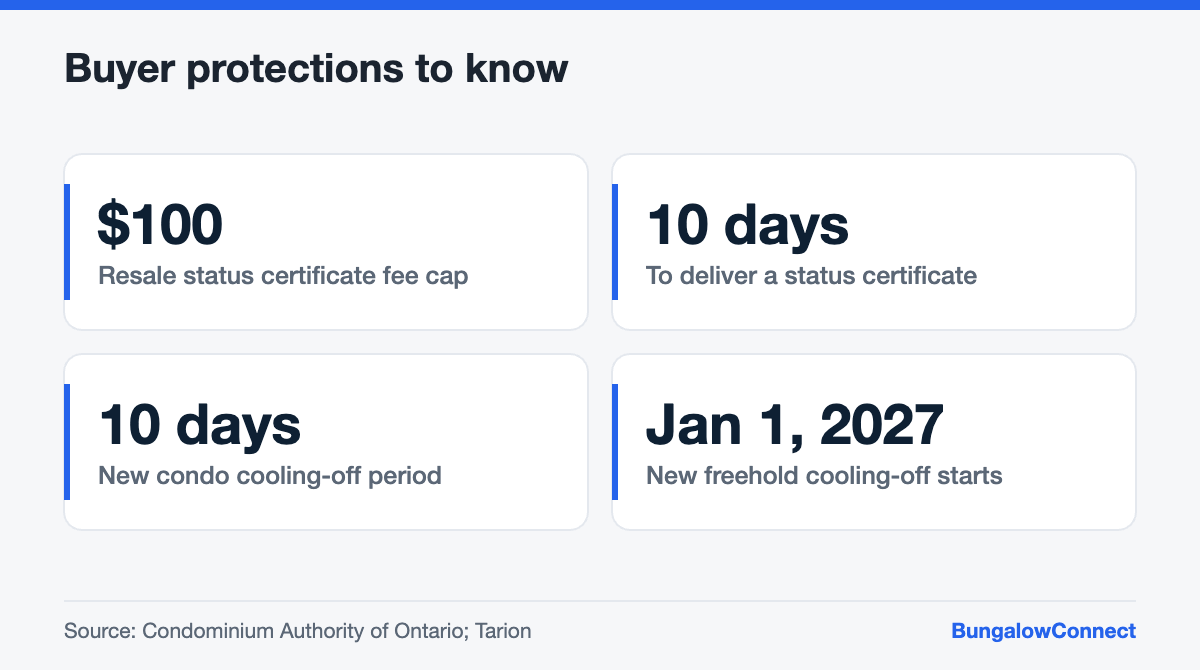
- Cooling-off period. New condo buyers have 10 days to rescind under the Condominium Act. New freehold buyers get a 10-day cooling-off period starting January 1, 2027, according to Tarion. Resale homes of any type have no cooling-off period.
- Deposit protection. Tarion covers freehold deposits up to $60,000 on homes of $600,000 or less, and otherwise 10% of the price up to $100,000. For condos, deposits must be held in trust and Tarion covers up to $20,000.
- The 45-day rule. From April 1, 2026, freehold buyers must notify Tarion within 45 days of signing to keep full deposit coverage.
The new-home HST rebates can also change the math. See new-build versus resale bungalows in 2026, and our guide to Tarion warranty coverage.
Insurance, financing and everyday costs
The ownership type changes more than the monthly fee:
- Insurance. In a standard condo, the corporation insures the building and you buy a unit owner’s policy for your contents, improvements and liability, plus coverage for your share of any deductible the corporation passes on. A freehold or POTL owner insures the whole house.
- Financing. Lenders count condo fees when they calculate your debt ratios, so a high fee reduces the mortgage you qualify for. They may also review the corporation’s documents.
- Property tax. You pay property tax on your own unit or lot in every case; it is not part of the condo fee.
- Decisions. In a condo, the board decides when to replace roofs or repave, and owners vote on some matters. In a freehold, you decide, and you pay when you decide.
Questions to ask before you buy a condo bungalow
- What exactly does the fee include, and how much has it risen over the past three years?
- When was the last reserve fund study, and does it call for fee increases?
- Are any special assessments planned or under discussion?
- Which parts of the exterior (roof, windows, doors, decks) are the owner’s responsibility?
- What are the rules on pets, rentals and renovations?
Resale: which holds value better?
There is no official bungalow-only price series, so the honest answer is that it depends on location and the specific community. A few principles hold:
- Land drives long-term value in the GTA. A freehold detached bungalow owns its land outright, which tends to support resale over time.
- Condo bungalows appeal strongly to downsizers, but the buyer pool can be narrower than for freehold homes, especially in age-restricted communities.
- A condo’s reputation for management and reserve fund health shows up in resale prices. Two similar units in different corporations can sell very differently.
For context, TRREB’s September 2026 benchmarks across all GTA areas were $1,196,400 for detached homes and $668,800 for townhouses, which include all townhouse styles, not just bungalows.
Frequently asked questions
What is a POTL condo?
POTL stands for parcel of tied land. You own your house and lot freehold, but the property is tied to a common elements condominium that owns shared features such as private roads, visitor parking or a clubhouse. You pay a monthly fee for those shared elements, usually lower than a standard condo fee, and you maintain your own home.
Are condo bungalows a good choice for retirees?
They can be. Exterior maintenance, snow and lawn care are often handled for you, and the communities tend to be quiet. Weigh that against the monthly fee, possible special assessments and rules on pets, rentals and renovations. Read the status certificate and rules carefully before you buy.
Do you pay land transfer tax on a condo bungalow?
Yes. Land transfer tax applies the same way to condo and freehold homes. In Toronto, you pay both the Ontario and municipal land transfer taxes; elsewhere in Ontario, only the provincial tax. Eligible first-time buyers can claim refunds of up to $4,000 provincially and $4,475 in Toronto.
Compare your options
Browse condo bungalows and bungalow townhouses side by side, or read about land lease communities if you want a lower purchase price.
This article is general information as of October 2026, not legal, tax, mortgage or financial advice. Rules and numbers change, so confirm the details for your situation with a licensed professional.