You need a 200-amp upgrade only if a licensed electrician’s load calculation shows your existing service cannot safely carry what you plan to add. Many older bungalows on 100 amps can handle a heat pump or an EV charger, but not always both, plus an electric range and dryer. Load-management devices can sometimes avoid an upgrade. In Toronto, an upgrade involves your electrician, the Electrical Safety Authority and Toronto Hydro, and the utility’s quote alone can take up to 60 days.
Key takeaways
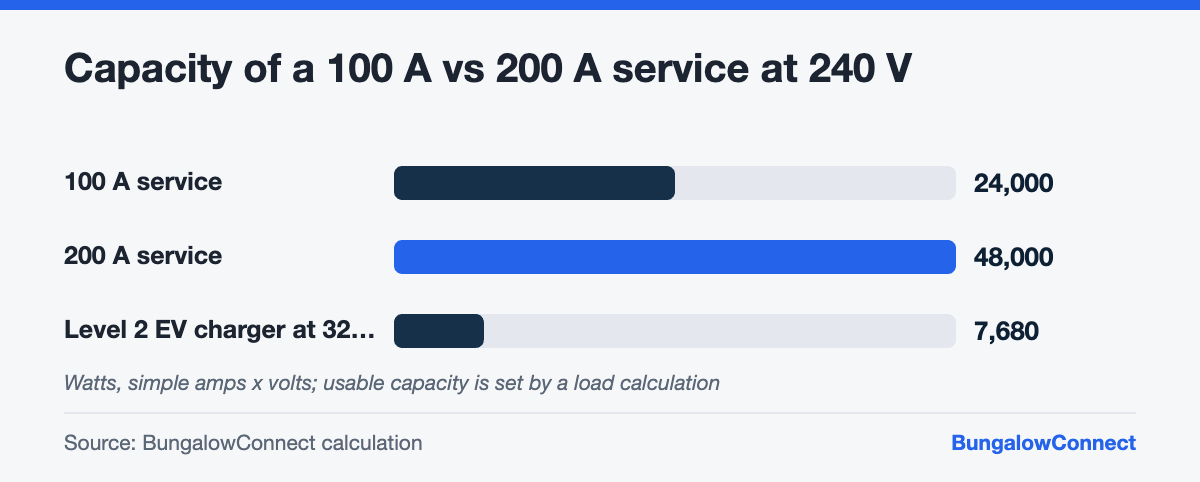
- A 100-amp, 240-volt service has a theoretical 24,000 watts; a 200-amp service has 48,000.
- A Level 2 EV charger drawing 32 amps uses about 7,680 watts on its own.
- Only a load calculation by a licensed electrician tells you whether you need more capacity.
- Load management, smaller chargers or a hybrid heat pump setup can sometimes avoid an upgrade.
- In Toronto, plan for weeks to months: Toronto Hydro quotes, ESA inspection, then connection.
Why older bungalows hit the limit
Many GTA bungalows were built in the 1950s to 1970s, when a house’s biggest electrical loads were a range, a dryer and lighting. Some still have their original service, and many were upgraded to 100 amps decades ago. That was plenty for a gas-heated home. It can be tight for an electrified one.
The typical modern additions are big, long-running loads: a heat pump or electric heat, a Level 2 EV charger, an induction range, a heat pump water heater or an electric dryer, and sometimes a hot tub or a basement suite with its own kitchen. A bungalow with a separate basement apartment can easily end up with two of everything.
Is 100 amps enough? How to tell
Simple arithmetic gives you a feel: amps times volts equals watts. At 240 volts, a 100-amp service is 24,000 watts in theory, and a 200-amp service is 48,000. A Level 2 charger set to 32 amps draws about 7,680 watts by itself, close to a third of a 100-amp service.
But the real answer is not that arithmetic. Electricians use a formal load calculation under the electrical code, which accounts for floor area, heating and cooling, major appliances and the fact that not everything runs at once. Ask your licensed electrical contractor for it in writing. It is the document that tells you whether you need an upgrade, and it is often what your utility and ESA will want to see.
Signs your panel is already struggling
- Breakers that trip when the dryer and range run together.
- No empty slots in the panel, or many “tandem” breakers squeezed in.
- An old fuse panel, or a panel brand an insurer has questioned.
- Lights that dim when the furnace or air conditioner starts.
If your bungalow also has older wiring, deal with it at the same time. Our guide to knob-and-tube and aluminum wiring explains why insurers care.
Ways to avoid or delay an upgrade
A service upgrade is not the only option. Depending on the load calculation, an electrician may suggest:
- Load management for the EV charger. Devices that pause or reduce charging when the house is drawing heavily are designed for exactly this problem.
- A lower charger setting. Many Level 2 chargers can be set to fewer amps. Overnight charging at a lower rate covers most commuters.
- A hybrid heating setup. Pairing a heat pump with your existing gas furnace for the coldest days can mean a smaller electrical load than all-electric backup heat. Our article on whether a heat pump is worth it in a bungalow compares setups.
- Gas or efficient appliances. A heat pump dryer or heat pump water heater draws much less than older electric versions.
Tip: Plan your electrification projects together, not one at a time. If a heat pump this year and an EV charger next year will push you past 100 amps, doing the service upgrade once, before either install, avoids paying an electrician to work in the same panel twice and lets you size the new panel for a future basement suite or garden suite too.
How a 200-amp service upgrade works in Toronto
Toronto Hydro’s service upgrade request page sets out the process:
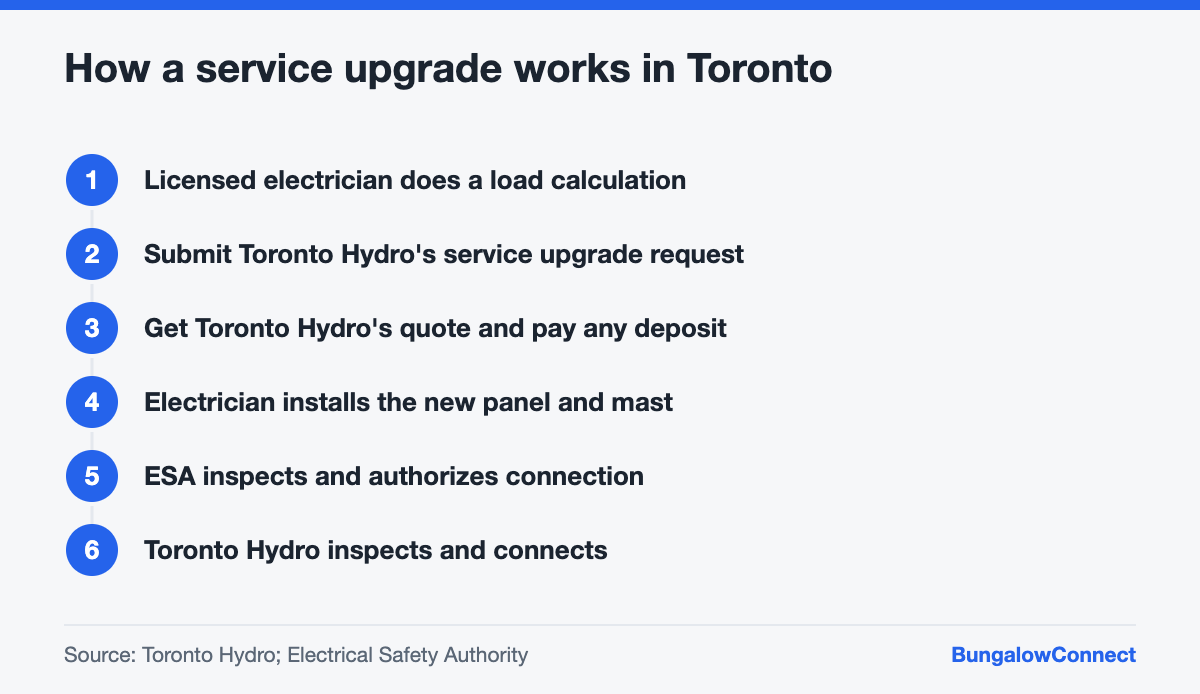
- You submit an online service upgrade request, ideally with your documents. A representative contacts you within 10 business days to confirm the scope.
- You may be asked for a design pre-payment, a deposit credited toward your project costs.
- Toronto Hydro issues a quotation, which it says typically takes up to 60 days after it has all required information.
- You or your contractor complete the site work. You then book an ESA inspection, and ESA’s connection authorization is needed before Toronto Hydro’s final inspection.
- Toronto Hydro says the upgrade itself takes about five business days for services of 750 volts or less. Simple overhead requests at 120/240 volts up to 200 amps may be eligible for real-time appointment booking.
Outside Toronto, your local electricity distributor runs its own version of this process. Start by asking your electrician which utility serves your street and what it needs.
Who can do the electrical work?
For work you hire out, ESA’s guidance is that it must be done by a licensed electrical contracting business, not a general contractor or handyperson, and that the ESA notification should be included in the contractor’s quote, according to its information for real estate agents. Homeowners may do their own electrical work in their home with a notification filed first, but a service upgrade involves utility coordination and is a job for a licensed contractor. Keep the ESA Certificate of Acceptance: buyers and insurers may ask for it when you sell.
Does a 200-amp panel add value to a bungalow?
It is rarely a headline feature, but it removes a question. Buyers who plan to add a heat pump, an EV charger or a basement suite increasingly ask about the service size, and a recent upgrade with ESA paperwork is an easy answer. It also pairs well with other energy upgrades; see our guide to the Home Renovation Savings Program for rebates that may apply to related energy upgrades.
Frequently asked questions
Can I install an EV charger on a 100-amp service?
Often, yes. Whether it fits depends on a load calculation that counts your heating, appliances and floor area. Many electricians install Level 2 chargers on 100-amp services using a lower amperage setting or a load management device that reduces charging when the house is busy. Ask for the calculation in writing before you buy a charger.
How long does a 200-amp upgrade take in Toronto?
The electrician’s work is usually quick, but the utility process sets the pace. Toronto Hydro says it contacts you within 10 business days, quotes typically take up to 60 days once it has everything, and the upgrade itself takes about five business days. ESA must inspect and authorize the connection first.
Do I need a permit to upgrade my electrical panel in Ontario?
Yes. Electrical work in Ontario needs a notification of work, which is ESA’s permit, filed before work starts. A licensed electrical contractor normally files it as part of the job and arranges the inspection. When the work passes, ESA issues a Certificate of Acceptance, which you should keep for insurance and resale.
Shopping for a bungalow ready for an EV?
Browse bungalows with a two-car garage and ask the listing agent about service size and panel age before you book a showing.
This article is general information as of October 2026, not legal, tax, mortgage or financial advice. Rules and numbers change, so confirm the details for your situation with a licensed professional.