When you buy a rural bungalow with a private well and septic system, make your offer conditional on a septic inspection (ideally with the tank pumped), a water quality test and a check of the well’s flow. In Ontario, bacteria testing of a private well is free through public health, while chemical testing is not. These checks protect you from some of the most expensive repairs a rural home can need, and they are standard practice outside the city.
Key takeaways
- Septic systems under 10,000 litres a day fall under Part 8 of the Ontario Building Code.
- Ask for septic permits and pump-out records, and make the offer conditional on an inspection.
- Free bacteria testing for private wells is available through Public Health Ontario labs; submit samples within 48 hours.
- Ontario’s “three units as of right” rule applies only where there is full municipal water and sewer.
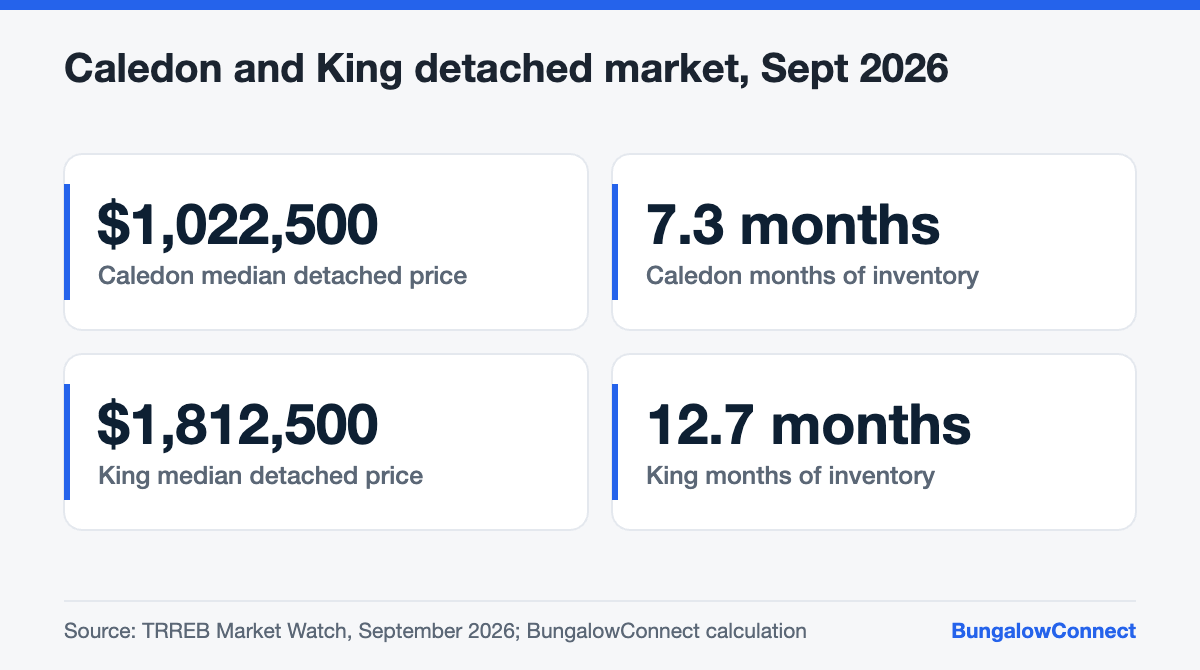
- Caledon and King had 7.3 and 12.7 months of detached inventory in September, so buyers have time to check.
Why rural bungalows are different
Bungalows on large lots are common across the countryside around the GTA: in Caledon and King, and further out in Dufferin, Simcoe and Durham. Buyers love the one-level layout, the space and the quiet. What they often underestimate is that the house runs on its own infrastructure. The well is your water utility. The septic system is your sewer. Nobody else maintains either.
Parts of Caledon and King, including some villages and towns, are on municipal water and sewer. Many rural properties are not. Confirm which you are looking at before you book the showing, because it changes your inspection, insurance and long-term plans. Our guide to rural versus urban living in Ontario covers the lifestyle side.
Checking the septic system
Septic systems that handle under 10,000 litres a day fall under Part 8 of the Ontario Building Code and are administered by the municipality or local health unit. Even seasonal properties must meet the full Code standard, and some municipalities run maintenance or re-inspection programs. Huntsville, for example, requires records or a third-party inspection for systems more than 25 years old, according to its septic systems page.
For a buyer, the practical steps are:
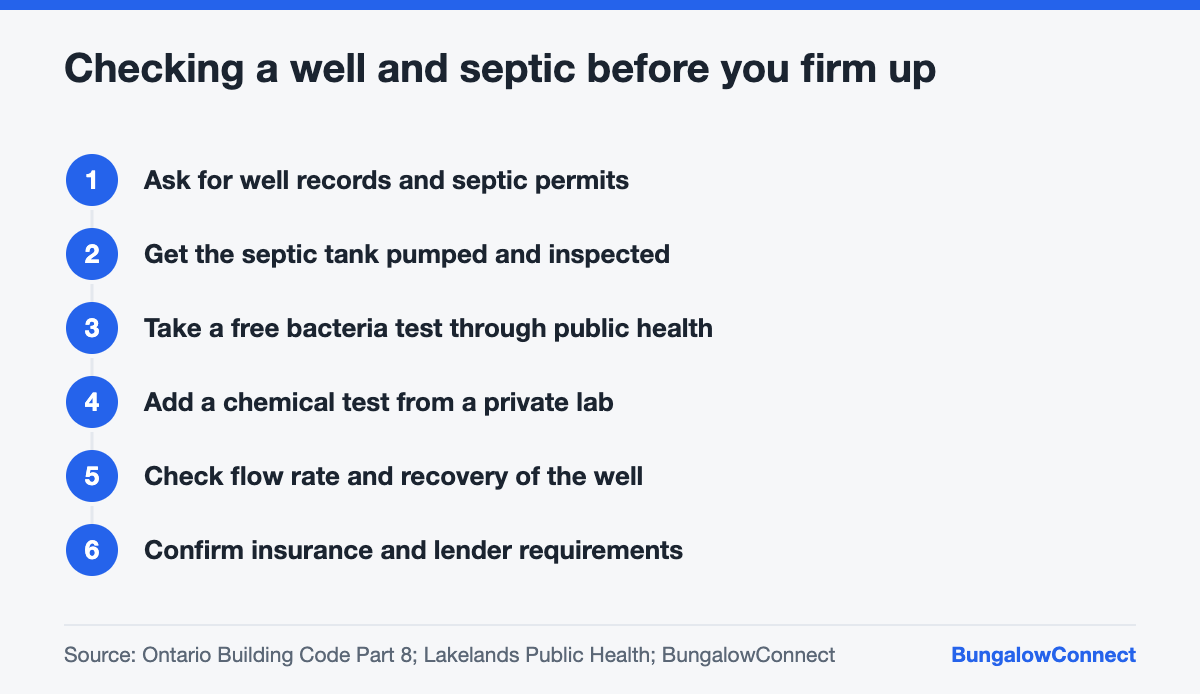
- Ask for the paperwork. The original septic permit, any repair permits, a site sketch showing the tank and leaching bed, and pump-out receipts.
- Pump and inspect. A septic contractor can pump the tank, check baffles and look for signs that the bed is failing. Pumping is the only way to see the tank properly.
- Walk the bed. Wet, lush or smelly patches over the leaching bed are warning signs. So is a driveway, pool or addition built over it.
- Check the size against the house. If the bungalow has been expanded, or a basement apartment added, the system may be undersized for the bedrooms now in the house.
Checking the well
A well needs two kinds of checks: water quality and water quantity.
Water quality
Bacteria testing for E. coli and total coliforms is free for private wells serving a home or cottage, through Public Health Ontario labs. As Lakelands Public Health explains, you pick up a kit at a local health unit, keep the sample cool and submit it within 48 hours. Testing at least twice a year is recommended. Chemical testing, for things like nitrates, sodium or metals, is not free, but it is worth paying a private accredited lab on a purchase.
Water quantity
Ask how deep the well is, when it was drilled and whether the owner has ever run short. A licensed well contractor can do a flow test to see how much water the well produces and how quickly it recovers. A shallow dug well and a drilled well behave very differently in a dry August.
Tip: Write well and septic checks as separate conditions with enough time to complete them, at least 7 to 10 business days in a rural deal. Labs, septic pumpers and well contractors are busier in spring and fall, and a five-day condition period built for a city house will not be enough.
Can you add a suite to a rural bungalow?
This catches many investors. Ontario’s rule allowing up to three units “as of right” on a residential lot, described in the province’s additional residential units notice, applies in settlement areas with full municipal water and sewer. A rural lot on a private well and septic system is not automatically covered.
That does not mean a suite is impossible. Many rural municipalities allow additional units under their own zoning, and Ontario’s second-unit guidance says a septic system can serve a second unit if it has enough capacity, or is upgraded. In practice, an extra unit often means a larger septic system, which needs space, a permit and money. Check with the township before you pay for suite potential.
Caledon and King: the market in September 2026
TRREB reports detached homes as one group, so these figures include rural and serviced properties, and two-storey homes as well as bungalows.
| Detached, Sept 2026 | Caledon | King |
|---|---|---|
| Sales | 50 | 16 |
| Average price | $1,147,898 | $2,131,250 |
| Median price | $1,022,500 | $1,812,500 |
| Active listings | 366 | 203 |
| Months of inventory | 7.3 | 12.7 |
| Sale price to list | 95% | 94% |
| Average days on market | 41 | 46 |
Both are firmly in buyers’ territory. Homes sold at 94% to 95% of list, and inventory was high. That gives you leverage to insist on proper rural conditions. Ontario land transfer tax on Caledon’s median price is $16,925, and on King’s median it is $32,725. Neither town charges a municipal land transfer tax.
Other rural checks for a bungalow
- Heating fuel. Propane, oil or electric? An older oil tank can be an insurance issue.
- Electrical. Older rural bungalows may have dated wiring. See our guide to knob-and-tube and aluminum wiring.
- Insurance. Distance to a fire hall and the lack of hydrants can affect premiums. Get a quote during your conditions.
- Road access. Confirm the road is municipally maintained year-round, and who plows a long driveway.
- Internet. Ask the seller for their provider and speeds if you work from home.
- Financing. Some lenders have rules for larger acreage or ask for water and septic reports. Ask early, and hold a rate while you search; see our rate hold guide.
Frequently asked questions
How do I test well water when buying a house in Ontario?
Pick up a free bacteria test kit from your local public health unit, collect the sample as instructed, keep it cool and drop it off within 48 hours. Public Health Ontario labs test it for E. coli and total coliforms. Add a paid chemical test from an accredited private lab, and ask a well contractor to check the flow.
Should I get a septic inspection before buying?
Yes. Make the offer conditional on a septic inspection, ideally with the tank pumped so the contractor can see inside. Ask for the permit, pump-out records and a sketch of the system. Replacing a failed leaching bed is a major expense, and you want to know about it before you are committed.
Can I build a basement apartment in a house with a septic system?
Possibly. Ontario’s three-units-as-of-right rule applies only where there is full municipal water and sewer, so rural lots depend on local zoning. The septic system must have enough capacity for the extra unit or be upgraded. Check with the township and a septic designer before you plan on rental income.
Explore rural bungalows near the city
Browse Caledon bungalows and King Township bungalows, and give yourself enough condition days to check the well and septic properly.
This article is general information as of October 2026, not legal, tax, mortgage or financial advice. Rules and numbers change, so confirm the details for your situation with a licensed professional.