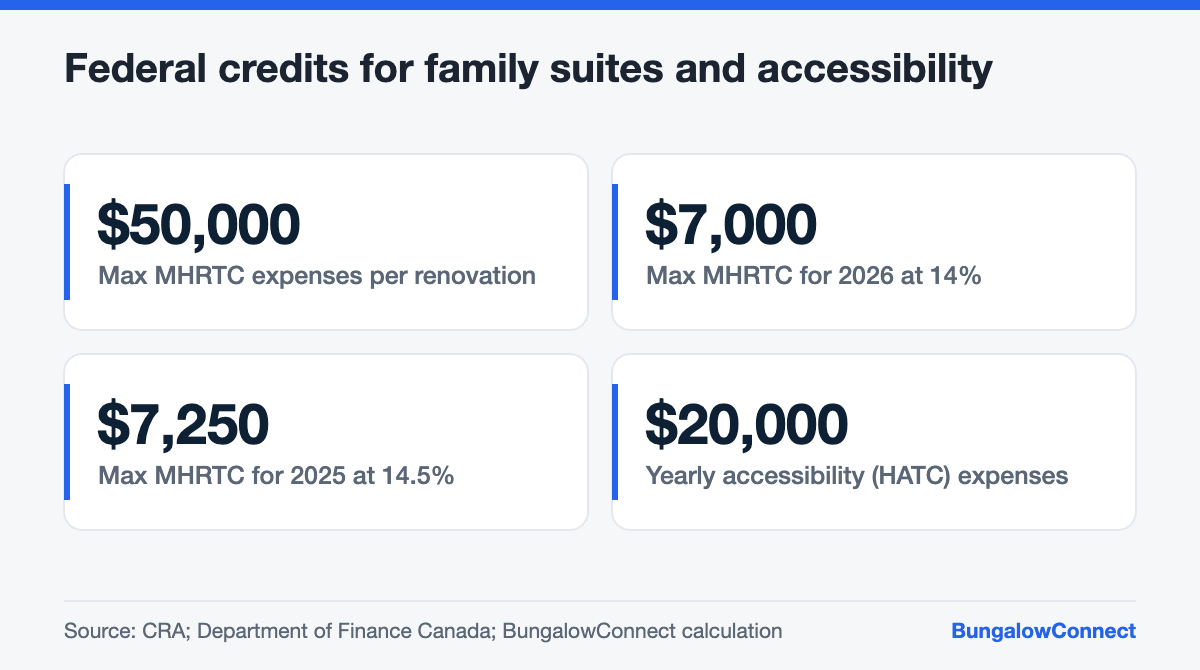
If you build a self-contained suite so a parent aged 65 or older, or an adult relative eligible for the disability tax credit, can live with you, the federal Multigenerational Home Renovation Tax Credit (MHRTC) refunds a share of up to $50,000 of costs. For 2026, with the lowest federal tax rate at 14%, that works out to a maximum of $7,000. Separate accessibility work can also qualify for the Home Accessibility Tax Credit.
Key takeaways
- The MHRTC is refundable, so you get it even if you owe no tax.
- CRA lists the 2025 maximum as $7,250 (14.5%); at 2026’s 14% rate, the maximum is $7,000.
- The suite must have its own entrance, kitchen, bathroom and sleeping area.
- Only one renovation can ever be claimed for each qualifying person.
- The same expense cannot be claimed under both the MHRTC and the accessibility credit.
Why bungalows suit in-law suites
A bungalow is the most natural house for two generations. The main floor gives an older parent step-free living, or the basement becomes a self-contained apartment for them while the family lives upstairs. Raised bungalows, with bright lower levels and often a side entrance, are especially easy to divide. Our article on bungalows for multigenerational families covers layouts; this one covers the tax credit.
How much is the Multigenerational Home Renovation Tax Credit?
According to CRA’s MHRTC page, you can claim up to $50,000 in qualifying expenses for each qualifying renovation. CRA states the 2025 credit as 14.5% of costs, up to $7,250. The rate is tied to the lowest federal personal income tax rate, which the Department of Finance set at 14% for 2026 and later years.
| Renovation completed in | Credit rate | On $50,000 of expenses | On $45,000 of expenses |
|---|---|---|---|
| 2025 | 14.5% | $7,250 | $6,525 |
| 2026 | 14% | $7,000 | $6,300 |
The 2026 figures are our calculation from the 14% rate; CRA’s 2026 tax-year pages will confirm the final numbers. The credit is claimed for the tax year in which the renovation period ends.
Who qualifies?
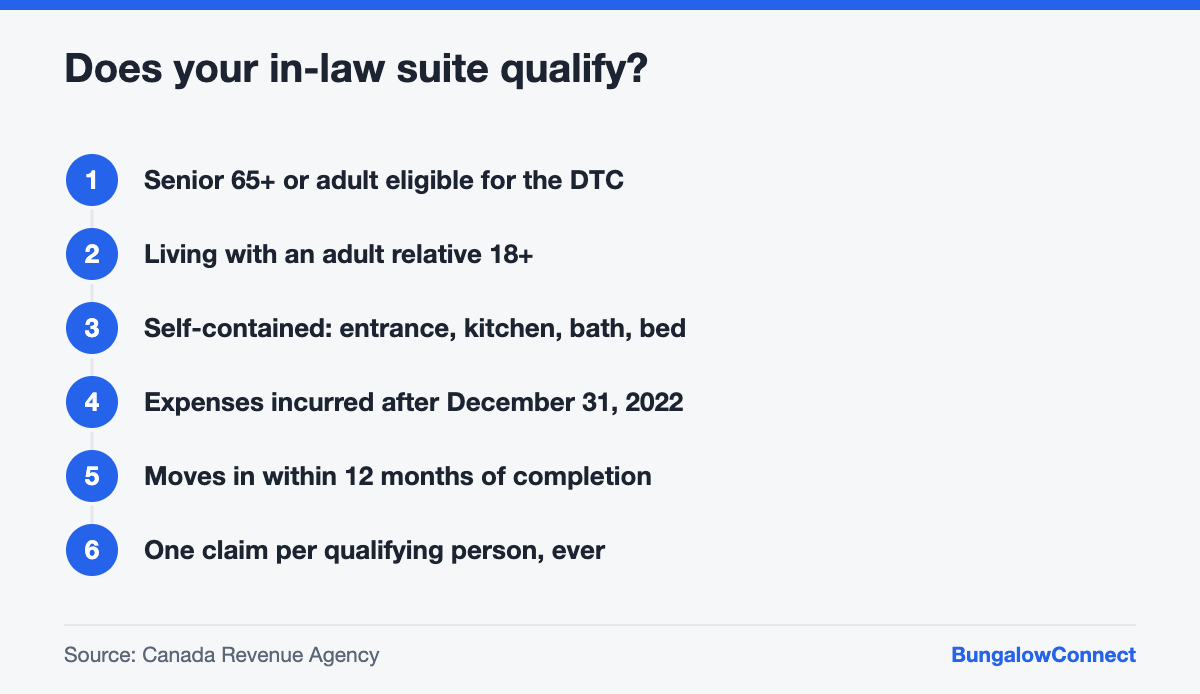
There are two people in every claim: the qualifying individual who will live in the suite (or the main house), and the qualifying relation they live with. CRA’s budget page on the credit sets out the rules:
- Qualifying individual: a senior who is 65 or older by the end of the tax year in which the renovation period ends, or an adult eligible for the disability tax credit.
- Qualifying relation: an adult (18 or older) who is the individual’s, or their spouse’s, parent, grandparent, child, grandchild, brother, sister, aunt, uncle, niece or nephew.
- Timing: expenses must be made or incurred after December 31, 2022.
- Occupancy: the qualifying individual must ordinarily live, or intend to live, in the home within 12 months after the renovation ends.
- One claim per person: only one qualifying renovation can ever be claimed for each qualifying individual.
What counts as a secondary unit?
CRA defines it as a self-contained housing unit with a private entrance, kitchen, bathroom facilities and sleeping area. It can be newly built, or created from existing living space that did not already meet local requirements for a secondary unit. A finished basement that is already a legal apartment does not qualify just because Mom moves in; creating the unit is the point.
What expenses count, and what does not
Qualifying expenses are the costs of the renovation that creates the unit: contractors, materials, permits and similar. CRA excludes:
- Routine repairs and maintenance.
- Household appliances and home entertainment electronics.
- Housekeeping, gardening and security monitoring.
- Financing costs, such as interest on a renovation loan.
- Work done by a non-arm’s-length person (such as a relative) unless they are registered for GST/HST.
- Any expense already claimed under the medical expense tax credit or the Home Accessibility Tax Credit.
Tip: In a bungalow basement conversion, ask your contractor to invoice the suite work separately from other jobs, such as a new roof or an upstairs kitchen. Clean invoices tied to the suite make the claim simple and protect it if CRA reviews it.
Adding the Home Accessibility Tax Credit
The Home Accessibility Tax Credit (HATC) covers renovations that help a senior or a person with a disability get into, move around or function in their home, or reduce the risk of harm. The annual expense limit is $20,000. It is non-refundable and calculated at the same lowest rate, so the maximum for 2026 is $2,800.
You cannot put the same expense through both credits. You can, however, claim different expenses under each. For example:
- You spend $80,000 creating a basement suite for your 70-year-old mother in 2026. You claim $50,000 under the MHRTC for a $7,000 refundable credit.
- Separately, you spend $12,000 adding grab bars, a curbless shower and a ramp at the side entrance. If those costs qualify for the HATC and were not part of the MHRTC claim, they could produce a $1,680 non-refundable credit.
Ask your accountant to allocate the costs before you file. For room-by-room ideas, see our guide to aging in place in a bungalow.
Records to keep for your claim
CRA can ask for proof after you file, sometimes years later. Keep a folder with:
- Every invoice and receipt for the suite, showing the supplier’s name and GST/HST number.
- The building permit and final inspection, which also show when the renovation period ended.
- Photos of the space before and after, showing the separate entrance, kitchen, bathroom and bedroom.
- Proof that your relative moved in within 12 months, such as a change of address or ID showing the new address.
- Proof of age, or the approved disability tax credit certificate, for the qualifying individual.
Building the suite: Code and cost basics
A tax credit does not replace a building permit. A basement in-law suite has to meet the same Building Code rules as a rental suite: ceiling height, fire separation, egress and smoke alarms. Our guide to basement ceiling height for a legal suite covers the first hurdle.
If you are thinking about a garden suite in the backyard instead, read about HST on garden suites before you budget; a family member living rent-free is treated differently from a tenant. Provincial rebates for energy upgrades may also apply to the same project, as covered in our Home Renovation Savings Program article.
Frequently asked questions
How much is the multigenerational home renovation tax credit for 2026?
The credit equals the lowest federal tax rate times up to $50,000 of qualifying expenses. With that rate at 14% for 2026, the maximum is $7,000 per qualifying renovation. CRA lists the 2025 maximum as $7,250 at 14.5%. The credit is refundable, so you receive it even if you owe no income tax.
Can I claim the credit for a garden suite?
Yes, if it is a self-contained unit with its own entrance, kitchen, bathroom and sleeping area, and the other conditions are met. CRA says the unit can be newly constructed. A garden suite also raises separate HST and permit questions, so speak with an accountant and your municipality before you start building.
Can my parent and I both claim the credit?
The claim for one renovation is capped at $50,000 of expenses, and only one qualifying renovation can ever be claimed for each qualifying individual. If more than one family member is eligible, the combined claims cannot exceed those limits. Check CRA’s guidance or ask an accountant how to split it before anyone files.
Looking for a bungalow that suits two generations?
Browse bungalows with a separate entrance and raised bungalows, the two layouts that convert most easily into an in-law suite.
This article is general information as of October 2026, not legal, tax, mortgage or financial advice. Rules and numbers change, so confirm the details for your situation with a licensed professional.